Research by Launch Sesame Sample Size: 40 founders Location: South Korea Data Snapshot: August 2026
Launch Sesame surveyed 40 prospective and early-stage foreign founders through startup competitions, founder networking events, and OASIS startup preparation programs in South Korea.
The research provides a descriptive snapshot of international founders actively entering or participating in Korea’s startup ecosystem. It focuses on previous business experience, pitching experience, technical execution capability, team composition, industry, and intended market.
A defining characteristic of the cohort is how early many participants were in their entrepreneurial journey. Most were building their first business, preparing to pitch for the first time, or operating without a co-founder. Rather than representing only established entrepreneurs entering Korea with mature companies, the group included many people developing their first startup while already participating in Korea’s startup infrastructure.
This is relevant when considering Korea as an environment for international entrepreneurship. The country provides multiple entry points for prospective and early-stage founders through entrepreneurship education, startup competitions, incubation, accelerators, government-backed support, founder communities, and entrepreneurship-related immigration pathways. The composition of this cohort is consistent with an ecosystem that allows founders to participate before they have large teams, extensive experience, or fully developed companies.
The findings are exploratory rather than representative of the entire foreign-founder population in Korea. They are intended to describe the founders surveyed through startup-focused programs and communities.
Key Findings
The cohort was predominantly early-stage and lean. 29 of the 40 participants were solo founders, 29 had never previously pitched a business, and 26 were building their first business.
Measure
Founders
Share of sample
Solo founders
29 of 40
72.5%
First-time pitchers (capability indicator #1)
29 of 40
72.5%
First-time business operators (capability indicator #2)
26 of 40
65.0%
Technical skillset to produce product independently (capability indicator #3)
15 of 40
37.5%
Had at least one capability indicator
23 of 40
57.5%
Had all three tracked experience or capability indicators
5 of 40
12.5%
The businesses themselves were diverse. Participants were working across 11 industry categories, and 72.5% were developing businesses outside ICT and digital. Three-quarters were also pursuing broad markets rather than primarily targeting either Korean or foreign customers.
Taken together, the findings describe a group of founders entering Korea’s startup ecosystem early, often with small teams and relatively little previous entrepreneurial experience, but with ambitions extending across a wide range of industries and markets.
Many Were First-Time Entrepreneurs
26 of the 40 participants, or 65%, had not previously operated a business. Fourteen had previous business experience.
The cohort therefore contained substantially more first-time entrepreneurs than repeat founders. For many participants, building a company in Korea was also their first practical experience of entrepreneurship.
Pitching experience followed a similar pattern. 29 participants, or 72.5%, had never previously pitched a startup or business concept. 11 had previous pitching experience.
Business and pitching experience also overlapped substantially. Of the 26 participants who had never run a business, 24 had also never pitched for one. Overall, 60% of the complete sample had neither previous business-running experience nor previous pitching experience.
These findings are particularly relevant in the Korean context. Startup competitions, accelerators, government-backed programs, and entrepreneurship education give founders opportunities to participate while they are still developing these skills. Within this cohort, participation in Korea’s startup ecosystem was clearly not limited to people who already had extensive entrepreneurial experience.
This suggests that Korea can function as more than a destination for established foreign companies. For some international founders, it also provides an environment in which they can begin developing as entrepreneurs.
Most Founders Were Building Lean
29 participants, or 72.5% of the sample, were building without a co-founder or other member of a founding team. Eleven were part of teams with two or more founders.
The high proportion of solo founders indicates that many participants were beginning with relatively low labor and operating costs. At this stage, responsibilities such as customer research, product development, operations, pitching, administration, and fundraising may initially sit with one person.
Solo founders do not necessarily work entirely independently. Early-stage founders can draw on external resources, digital tools, and founder communities as they develop their businesses.
Korea’s startup infrastructure is relevant in this respect. Many programs allow founders to access mentoring, education, workspace, networks, competitions, funding opportunities, and other forms of support before they have assembled a large internal team. This can make the ecosystem particularly useful for entrepreneurs beginning with a lean operating model.
The cohort therefore reflects a form of entrepreneurship in which founders can start small internally while using the broader ecosystem to add knowledge, relationships, and capabilities as the company develops.
Browse All 500+ Startup Support Programs
From Commercialization, R&D Funding, Facilities and Workspaces, Mentoring Programs, Hiring Subsidies, and Global Expansion, discover all ₩3.4 trillion in startup support in one place.
15 of the 40 founders, or 37.5%, were classified as having the technical skills required to independently build or substantially develop their own product.
For this research, a founder was considered technically capable if they had the skills to participate directly in building the product rather than relying entirely on an external developer or technical team. This generally included backgrounds in software engineering, programming, technical data or analytics work, workflow automation, or comparable roles that would allow someone to create functional software, automate processes, or contribute directly to digital product development.
The classification measures technical execution capability rather than general technology literacy. Familiarity with AI tools, no-code platforms, productivity software, or digital products alone was not sufficient.
The result does not imply that technically capable founders could build every part of their startup independently. It indicates that technical product-building capability was already present within the founder’s own skill set.
The remaining participants brought capabilities from other areas and would be more likely to rely on co-founders, employees, contractors, external technical partners, or tools to develop their products. This reflects the varied backgrounds of founders entering at an early stage, where different capabilities may be added as the business develops.
Founders Entered With Different Combinations of Experience
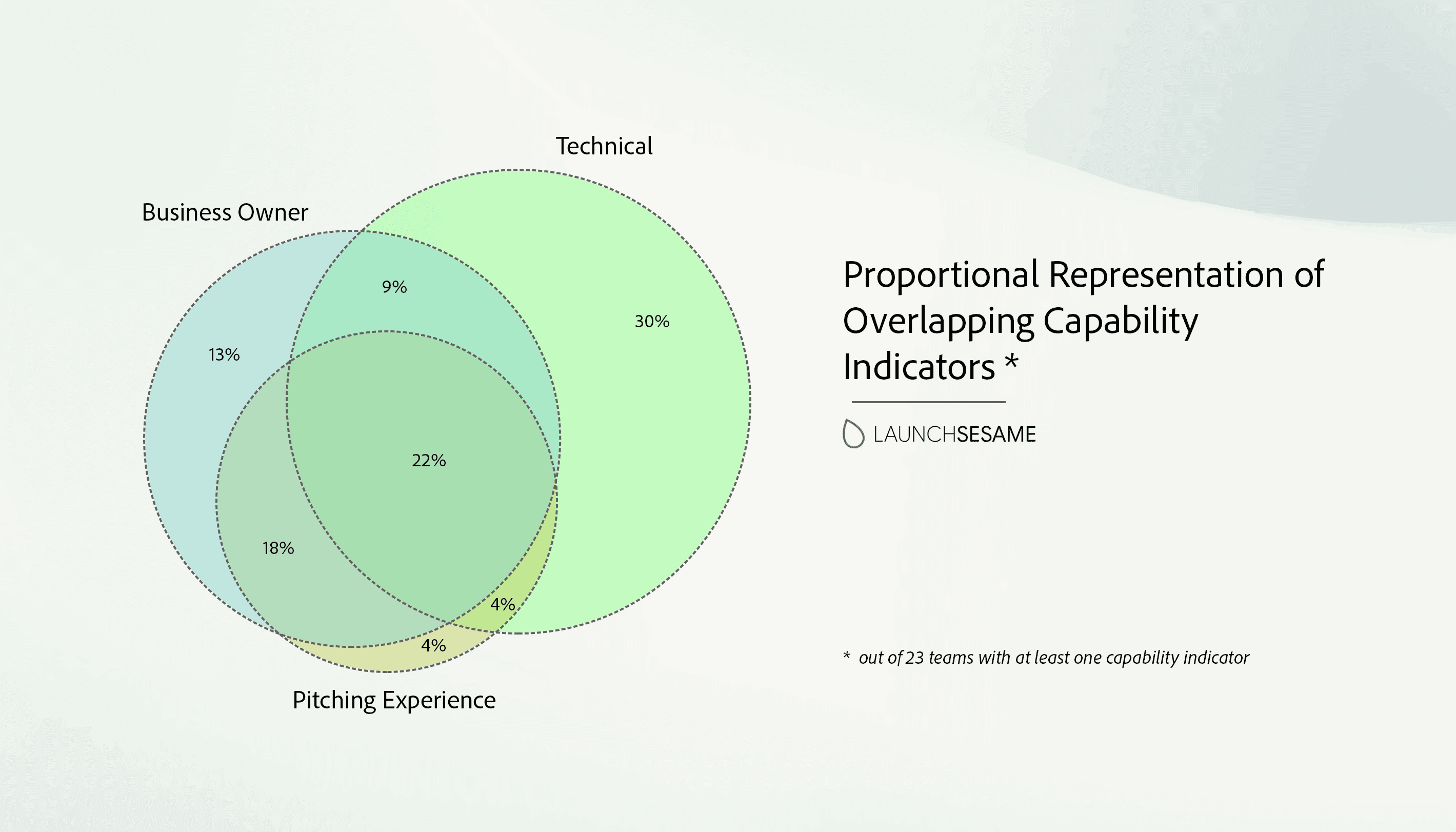
Previous business experience, pitching experience, and technical execution capability were also analyzed together.
Of the 40 founders:
43% had none of the three tracked indicators.
28% had one.
18% had two.
13% had all three.
Overall, 23 of the 40 participants, or 57.5%, had at least one of the three tracked forms of experience or capability.
The distribution shows that there was no single founder profile. Some participants had technical backgrounds but little previous business experience. Others had previously operated businesses but did not have the technical skills to develop their products directly. Five founders entered with experience across all three dimensions.
For an early-stage startup ecosystem, this variation matters. Founders do not necessarily enter with every capability already represented internally. Programs, communities, mentors, service providers, technical partners, and co-founders can help supplement the areas that are not yet present within the initial team.
Korea’s startup environment provides many of these external resources. This can be particularly valuable for first-time and solo founders, who may develop capabilities progressively rather than assemble a complete organization before beginning.
Founders Were Building Across Multiple Industries
Participants were developing businesses across 11 industry categories.
Industry
Founders
Share
ICT / Digital
11
27.5%
General
8
20.0%
Education
5
12.5%
Tourism
3
7.5%
Bio / Health
3
7.5%
Cosmetics
3
7.5%
Agriculture / Food
2
5.0%
Energy
2
5.0%
Small Business
1
2.5%
Fintech
1
2.5%
Manufacturing
1
2.5%
ICT and digital businesses formed the largest single category at 27.5%. However, 72.5% of participants were developing businesses outside that category.
The cohort therefore represents a broader range of entrepreneurial activity than software startups alone. Participants were developing businesses in education, tourism, health, cosmetics, agriculture and food, energy, financial services, manufacturing, and other areas.
Everyone is doing either K-beauty or tourism. I want something less saturated.
founder in their ideation stage
This diversity suggests that international founder participation in Korea is not concentrated around one type of company. The ecosystem is attracting people pursuing both technology-driven businesses and more traditional commercial models.
Most Founders Were Pursuing Broad Markets
Participants were also categorized according to the primary market their businesses intended to serve.
Intended market
Founders
Share
Broad / all markets
30
75.0%
Primarily foreigners
8
20.0%
Primarily Koreans
2
5.0%
30 of the 40 participants were developing businesses intended for broad markets rather than primarily serving either Korean or foreign customers.
8 participants were primarily targeting foreign customers, while 2 were mainly focused on Korean customers.
The results indicate that most foreign founders in the cohort were not limiting their business concepts to expatriate or foreigner-focused markets. Their businesses were generally designed around broader commercial opportunities.
This provides useful context when considering the role of foreign entrepreneurship in Korea. International founders participating in the ecosystem are not necessarily building businesses only for other international residents. Many are using Korea as an environment in which to develop products and services with wider market ambitions.
What This Research Tells Us
The clearest characteristic of this cohort is its early stage of development. Most participants were solo founders, most had not previously operated a business, and most had not previously pitched a startup.
These characteristics should not be interpreted simply as weaknesses. They show that many international entrepreneurs are entering Korea’s startup ecosystem before they have accumulated extensive entrepreneurial experience or assembled larger founding teams.
That is significant because Korea has developed multiple entry points for founders at this stage. Startup education, competitions, incubation programs, accelerators, government-backed support, founder communities, and entrepreneurship-related visa pathways allow people to begin participating while they are still testing ideas, developing skills, and building their companies.
Within this cohort, Korea therefore appears to function both as a startup destination and as an environment for founder development. A substantial number of participants were not relocating mature businesses into Korea. They were actively developing their first companies while participating in the Korean ecosystem.
The data also shows that these founders were pursuing varied ambitions. Participants represented 11 industries, and 75% were developing businesses intended for broad markets. The cohort was early-stage, but it was not narrowly concentrated by industry or customer type.
For Korea, this points to a potentially important role in international entrepreneurship. An ecosystem that is accessible to first-time founders and lean early-stage teams can give prospective entrepreneurs the confidence and infrastructure to move from an initial idea toward an operating company. Programs, networks, funding pathways, and other startup resources can help founders progressively develop the skills and capabilities they need.
The findings from this cohort are therefore consistent with a Korean startup ecosystem that enables first-time entrepreneurs and lean early-stage teams to develop, build, and ultimately scale their ideas.
Methodology
This research draws on information collected from 40 prospective and early-stage foreign startup founders surveyed in South Korea.
Participants were surveyed through:
startup competitions;
founder and startup networking events; and
OASIS startup preparation programs.
These channels provided access to international entrepreneurs who were actively exploring or pursuing entrepreneurship in Korea.
The sample was not randomly selected. It therefore represents a specific cohort of founders participating in startup-related programs, competitions, and communities rather than a statistically representative sample of all foreign entrepreneurs in Korea.
Launch Sesame asked participants a consistent set of questions about their startup background, intended business, prior experience, and team composition and recorded their responses for analysis.
The variables analyzed were:
industry;
intended primary market;
technical execution capability;
previous experience running a business;
previous pitching experience; and
whether the participant was building alone or as part of a team.
Percentages in this report are calculated against the complete sample of 40 founders unless otherwise stated.
Definitions
Previous business experience
Whether the participant had previously run a business.
Previous pitching experience
Whether the participant had previously pitched a business or startup.
Technical execution capability
Whether the participant had the underlying technical skills required to independently build or substantially develop their own product.
This generally included skills associated with software engineering, programming, technical data or analytics work, workflow automation, or comparable experience that enabled the founder to directly create or develop a functional product.
General technology literacy or familiarity with AI, no-code, and productivity tools was not by itself considered sufficient.
The classification reflects practical product-building capability rather than a standardized assessment of technical proficiency.
Solo founder
A participant was classified as a solo founder if they were pursuing the business without a co-founder or other member of a founding team at the time the information was collected.
This classification refers to the founder’s internal team and does not exclude the use of external contractors, advisors, mentors, or service providers.
Intended market
The primary customer market associated with the participant’s business concept. Participants categorized as “broad / all markets” were not primarily targeting either foreign or Korean customers exclusively.
Research Limitations
This research has several limitations that should be considered when interpreting the findings.
First, the sample is relatively small at 40 participants. Second, participants were surveyed through startup competitions, networking events, and OASIS startup preparation programs rather than selected through random sampling. People participating in these environments may differ from foreign entrepreneurs who do not engage with formal startup programs or founder communities.
The research also intentionally focuses on prospective and early-stage founders. Its findings should not be generalized to established foreign-owned businesses or later-stage startup founders.
Finally, some variables involve researcher classification rather than standardized assessment. This is particularly relevant to technical execution capability, which was determined based on whether a participant appeared to have the skills necessary to directly build or substantially develop a product.
The findings should therefore be interpreted as descriptive evidence about this specific early-stage founder cohort rather than population-level estimates for foreign entrepreneurship in Korea.
About Launch Sesame Research
Launch Sesame researches the experiences of international founders building businesses in South Korea.
Our research focuses particularly on the earliest stages of the founder journey, including startup preparation, government programs and funding, founder visas, incorporation, and the practical process of entering Korea’s startup ecosystem.
Korea has developed substantial infrastructure around entrepreneurship, including programs that allow international founders to participate while their companies are still at an early stage. Launch Sesame studies how founders interact with this infrastructure and how different parts of the ecosystem support progression from an initial idea to an operating company.
By combining primary founder research with analysis of Korea’s startup support infrastructure, Launch Sesame aims to make the ecosystem easier for international founders to understand and navigate.
Suggested citation
Launch Sesame. (August 2026). Early-Stage Foreign Founders in Korea: August 2026 Research Snapshot. Launch Sesame Research.
Frequently Asked Questions
Yes - foreigners have various avenues to start a business in Korea. The majority of those surveyed in this research were pursuing the D-10-2 to D-8-4 visa path that allows non-residents to start their business through a mix of government run programs, pitch competitions, innovation (e.g. IP filings), and/or capital injections.
No. A foreign founder does not need a Korean co-founder simply to establish a business in Korea, although visa requirements, regulated industries, and the chosen business structure can affect the setup process. Korea's foreign-founder programs also explicitly accept international founders and, in some cases, pre-startup teams without an existing Korean company.
The research in this article reflects this in practice: 29 of the 40 foreign founders surveyed were building without a co-founder, making solo entrepreneurship the most common team structure in the sample.
Foreign founders can access several forms of support depending on their visa status, business stage, industry, and individual program eligibility. These include entrepreneurship education, mentoring, incorporation support, startup competitions, incubation, commercialization funding, R&D programs, accelerators, networking, and visa-related support.
Programs specifically serving international founders include OASIS, the K-Startup Grand Challenge, and foreign-founder commercialization initiatives operated or supported by Korean government agencies. Some programs are available even before a founder has incorporated a Korean company.
Yes, foreign founders can qualify for some Korean government-backed startup programs, although eligibility varies considerably by program. Some initiatives are specifically designed for foreign entrepreneurs, while other Korean startup grants have requirements related to residency status, incorporation, company age, industry, location, or founder characteristics.
You can directly explore and filter over 500 recurring programs in both Korean and English here.
Younis Shuaib
13 min read
Need Funding?
Answer a few questions to discover grants you're eligible for.