In our August 2026 research on early-stage foreign founders in Korea, 29 of the 40 founders we surveyed had never pitched a startup before. Among the 26 founders who had never previously run a business, 24 had also never pitched one.
That matters because pitching often forces founders to do something they may otherwise avoid: reduce a complicated idea into a clear story. Even when parts of the business are still based on vague assumptions, building a deck helps you decide what the problem actually is, who you are solving it for, why the opportunity matters, and how the business could work. Rehearsing that story also makes it much easier to speak about the idea consistently.
Most [early-stage founders] ... had not previously pitched a startup.
August 2026 Survey of Early-Stage Founders
Key Slides for Any Pitch Deck
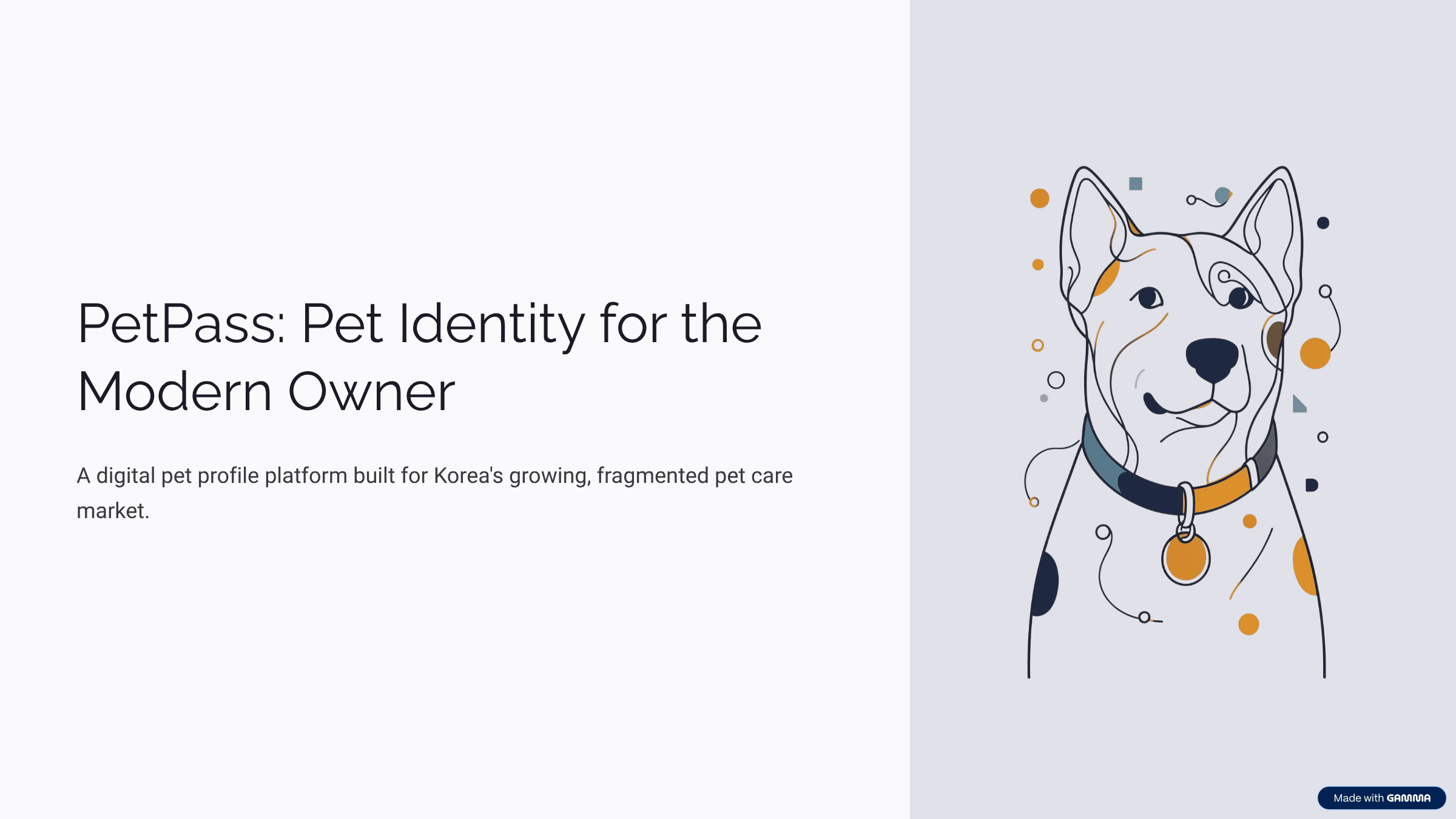
With feedback from other founders, we decided to publish the following guide to give prospective entrepreneurs some structure when they need it most. And to make things more concrete, we created a fictitious startup called PetPass - a digital profile that allows pet owners to keep and share important information about their pet across vets, boarding facilities, sitters, groomers, and other care providers.
For visualization, we then used Gamma to turn a rough set of founder notes into an eight-slide first pitch. The slides below are not meant to represent the only possible structure, but they cover the core questions that most early-stage pitches should answer.
Explain Your Idea in One Sentence
The opening slide should make the company understandable immediately. You do not need to explain the entire business model, product architecture, or long-term vision. You simply need to give the audience a clear mental model of what the company does.
For PetPass, the core idea is straightforward: a portable digital profile for a pet’s important care and health information. That is much stronger than opening with something vague like “the future of pet identity” or filling the slide with industry terminology. If the audience cannot roughly explain your startup back to you after the first slide, the rest of the pitch becomes harder.
State the Problem So Anyone Can Understand It
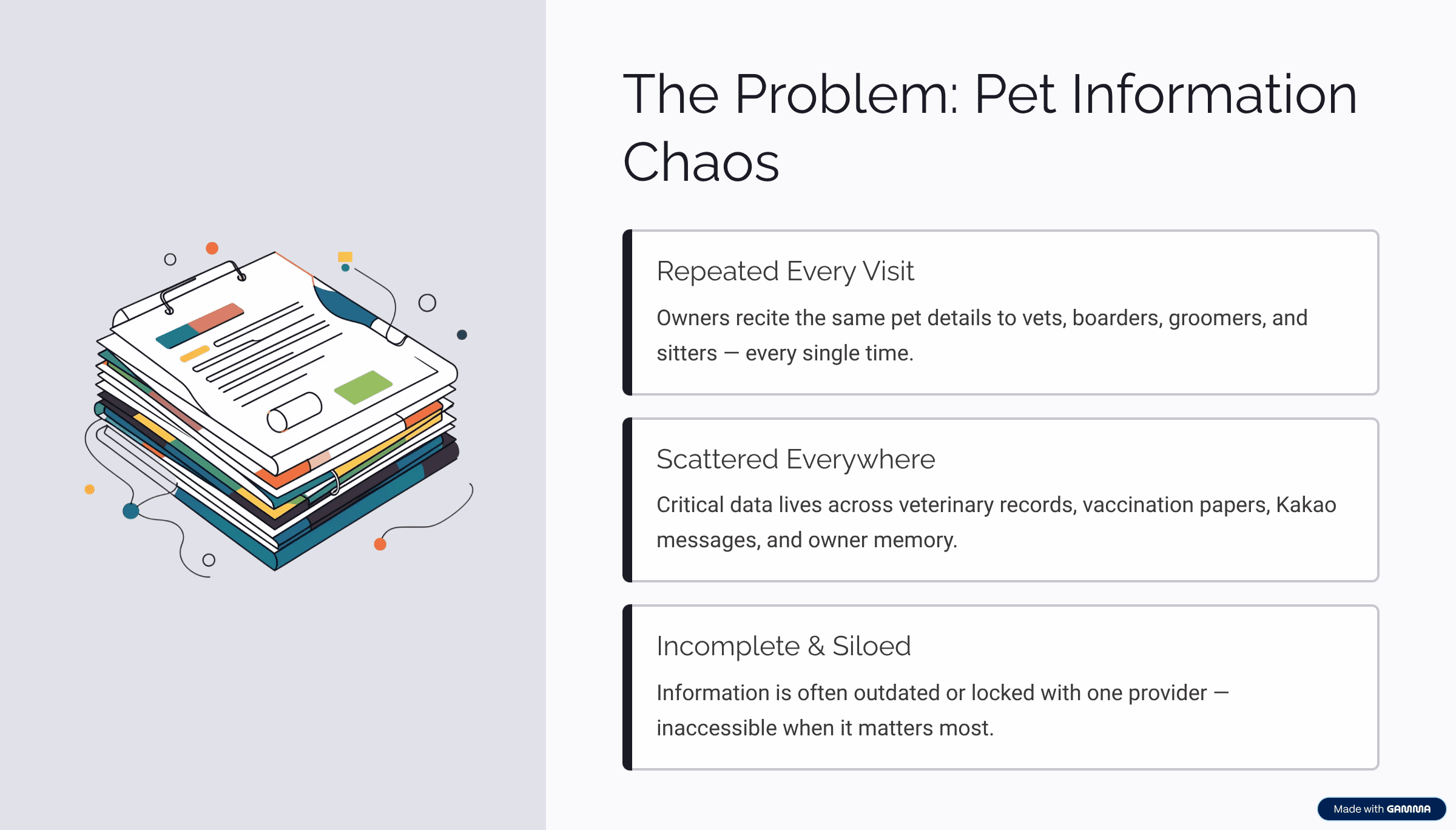
Your problem slide should work even for someone who is not your customer. A non-pet owner may never have dealt with pet records, but they can still understand the frustration of repeatedly giving the same important information to different businesses.
In PetPass’s case, the problem is that pet information is often scattered across vet records, vaccination documents, Kakao messages, boarding instructions, and the owner’s own memory. The point is not to make the problem sound dramatic. It is to make it concrete. Simple problems that clearly exist are usually more convincing than complicated statements built around industry jargon.
Show That the Opportunity is Large Enough
Once the problem is clear, the audience needs some evidence that enough people experience it for the business to matter. This is where a few well-chosen numbers can do a lot of work.
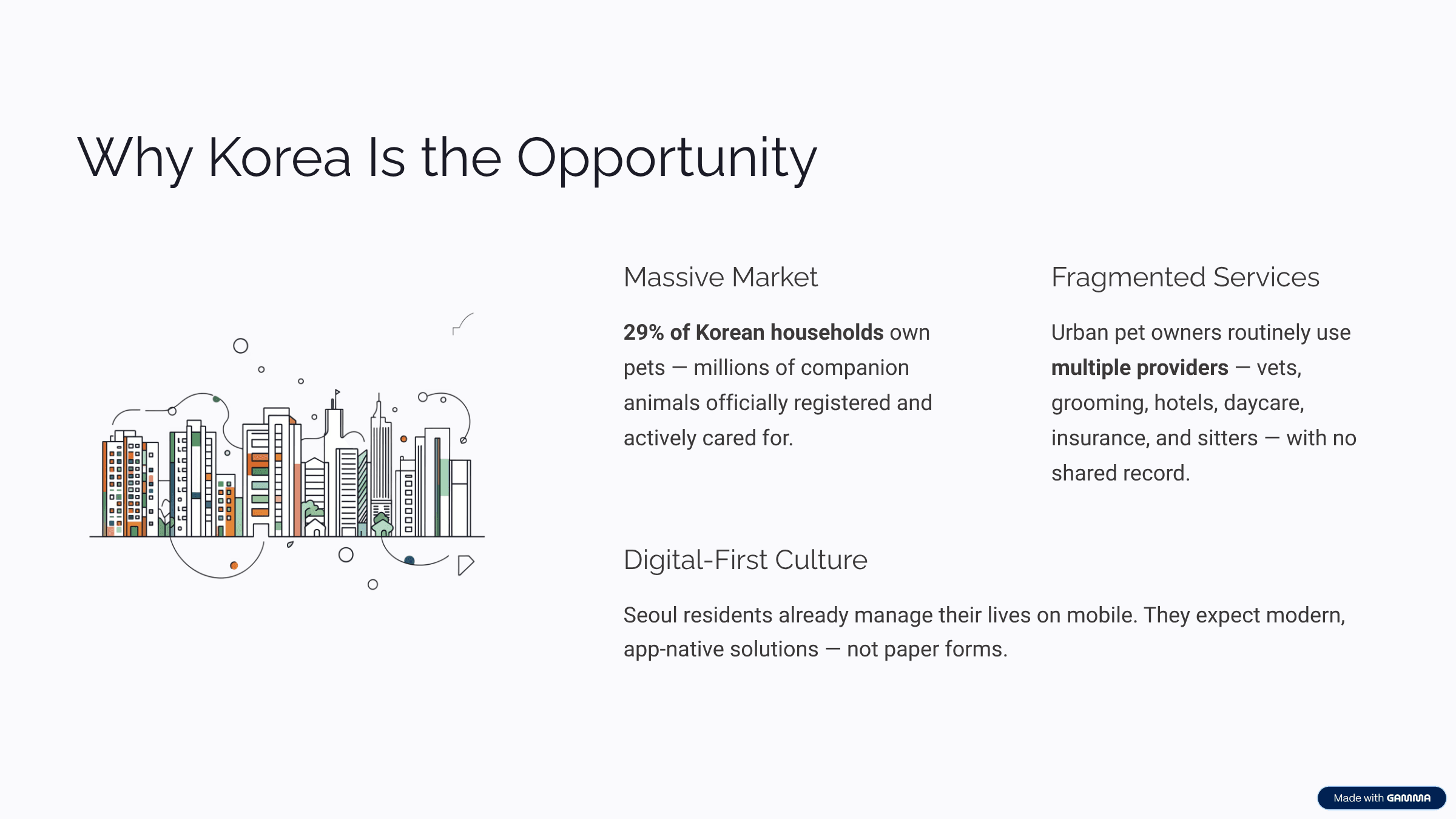
For PetPass, Korea’s relatively high rate of pet ownership provides a useful starting point. The goal is not to find the biggest possible market-size figure and put it on a slide. It is to show that there is a meaningful population of potential users and that the surrounding market is active enough to support the idea. Numbers related to customer count, spending, market growth, service usage, or adoption are usually more useful than a very broad global TAM.
Whatever numbers you use, make sure they are sourced. Precise-looking statistics can make a deck feel more credible, but only if you can defend where they came from.
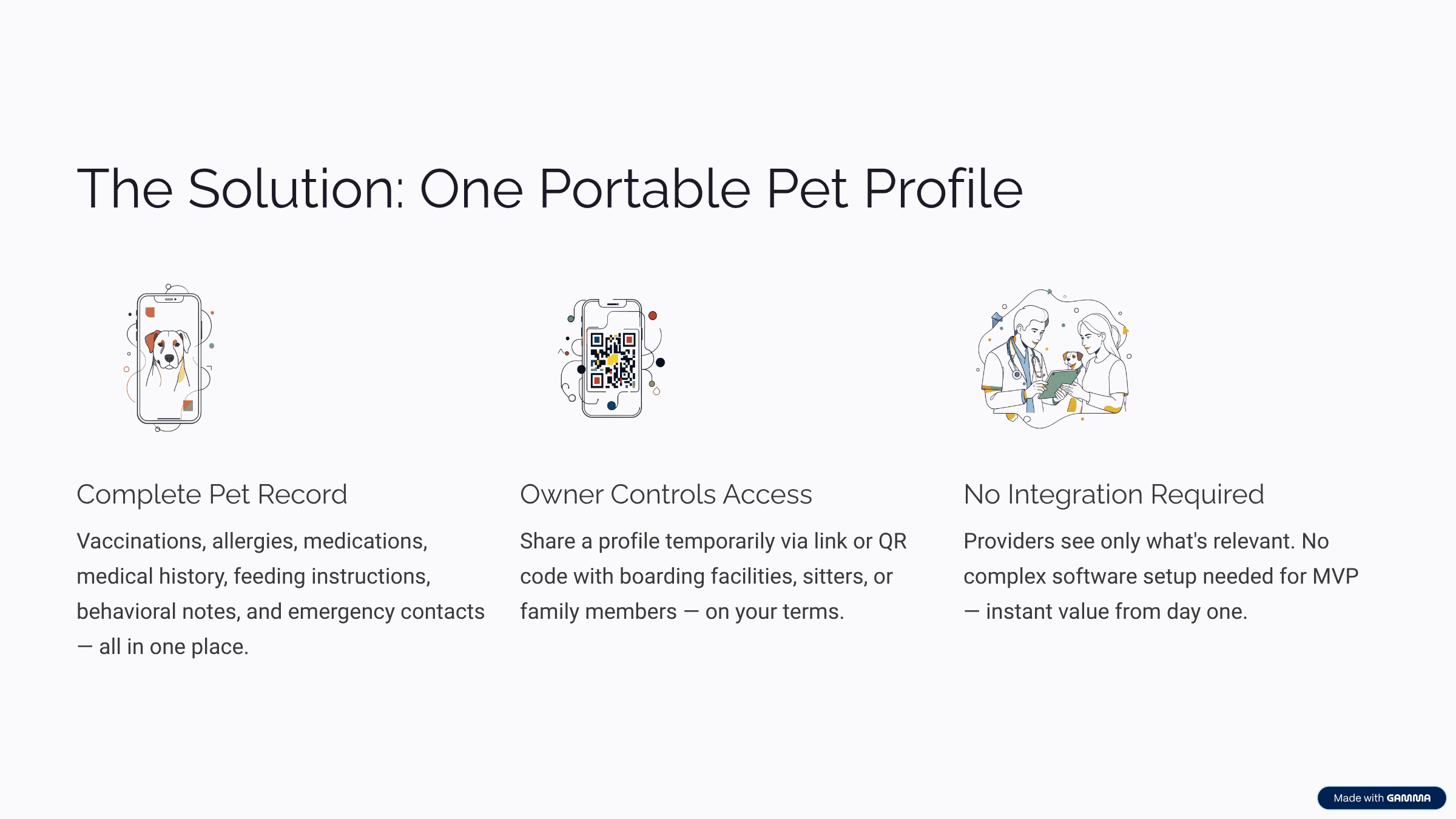
Explain the Core Solution
Early-stage ideas often become overloaded with features very quickly. Founders think about everything the product could eventually do, then try to fit all of it into the pitch.
PetPass could eventually include reminders, insurance information, veterinary integrations, emergency QR codes, family sharing, boarding integrations, and other features. But the core value is much simpler: one pet profile that the owner controls and can selectively share with other people or businesses.
That is the idea the audience should remember. You will have many chances later to explain additional features. The first pitch should focus on the one thing that makes the product useful.
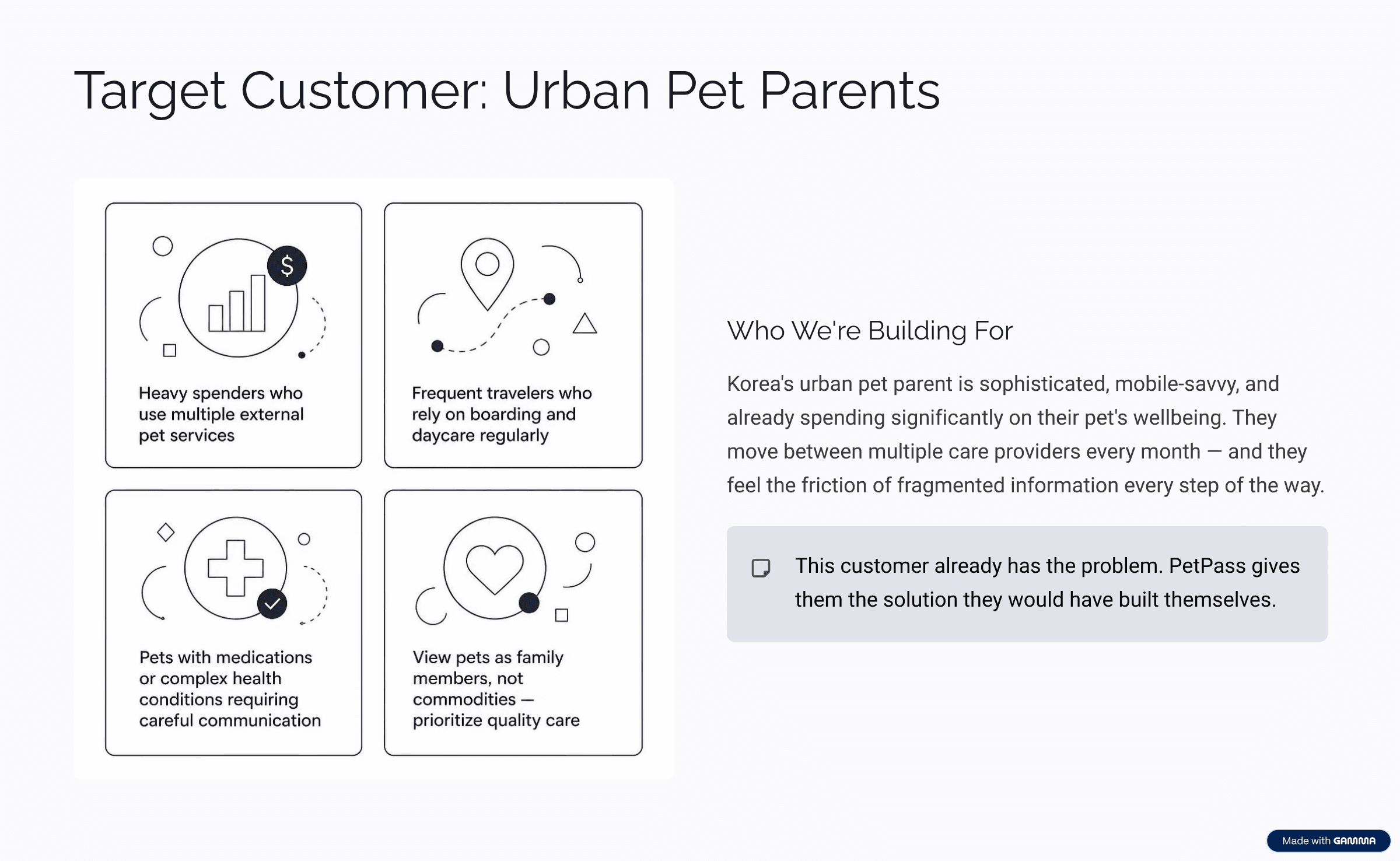
Describe Exactly Who Has the Problem
“Pet owners” is technically a customer segment, but it is still too broad to be useful. A better customer definition explains who feels the problem most strongly and why.
For PetPass, the initial customer might be urban pet owners who regularly use external pet-care services. That could include people who travel often, owners of pets with medications or ongoing health needs, or people who regularly use boarding, daycare, grooming, and multiple veterinary providers.
You can absolutely have more than one persona, but they should still fall under a coherent category of people experiencing the same core problem. The clearer the customer becomes, the easier it is to explain both why they need the product and how you might reach them.
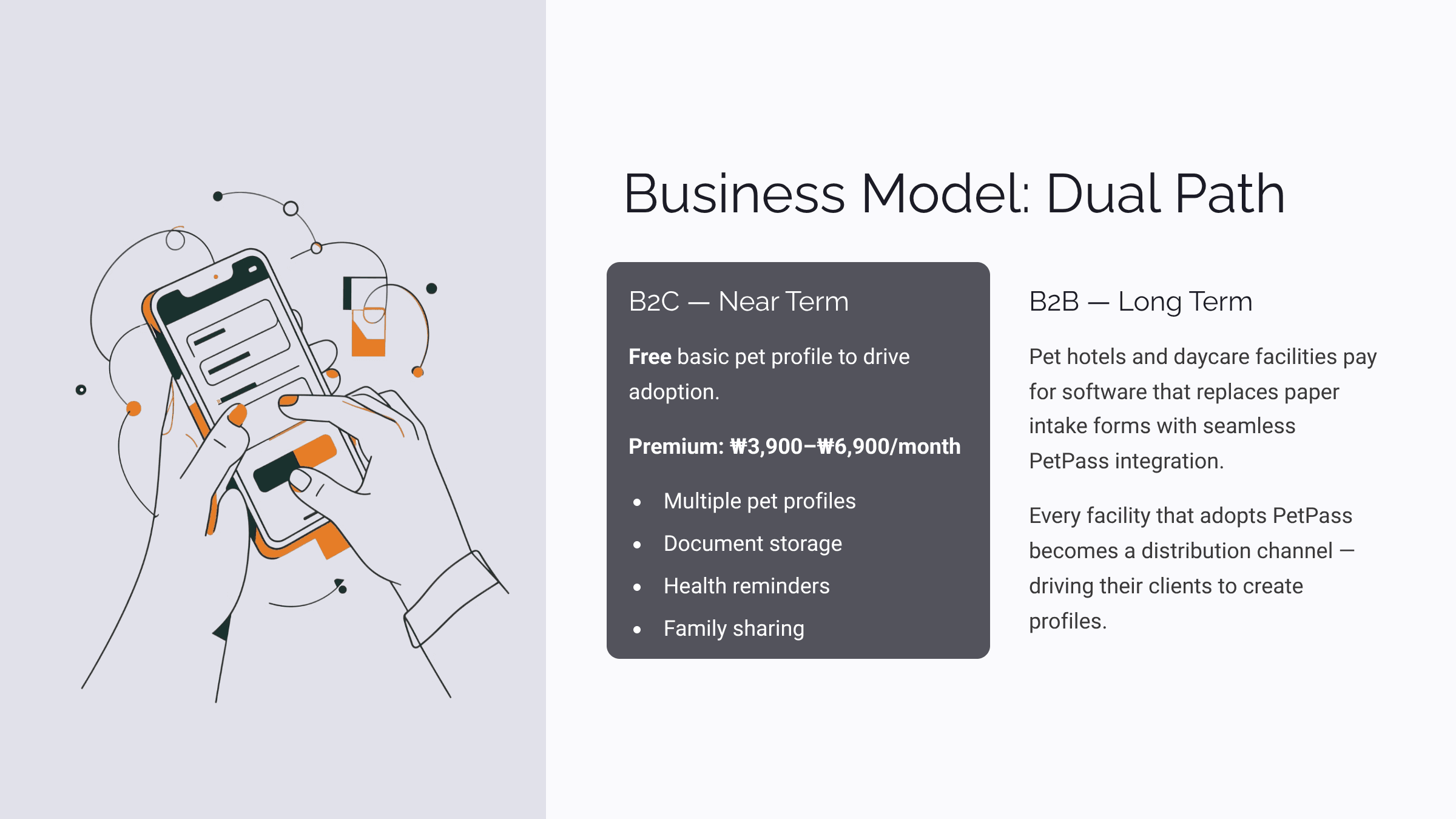
Explain How the Business Makes Money
A first pitch does not need a perfectly validated business model, but it should show that you have thought seriously about who might pay and why.
For PetPass, the initial idea is a consumer model with a free basic profile and paid features, while a longer-term B2B model could involve pet hotels, daycare facilities, or other care providers paying for software that integrates with PetPass. At this stage, both are still hypotheses.
Including some longer-term perspective can be useful because it shows that the business may become larger than its first use case. The important thing is to distinguish clearly between what you are doing now and what might become possible later.
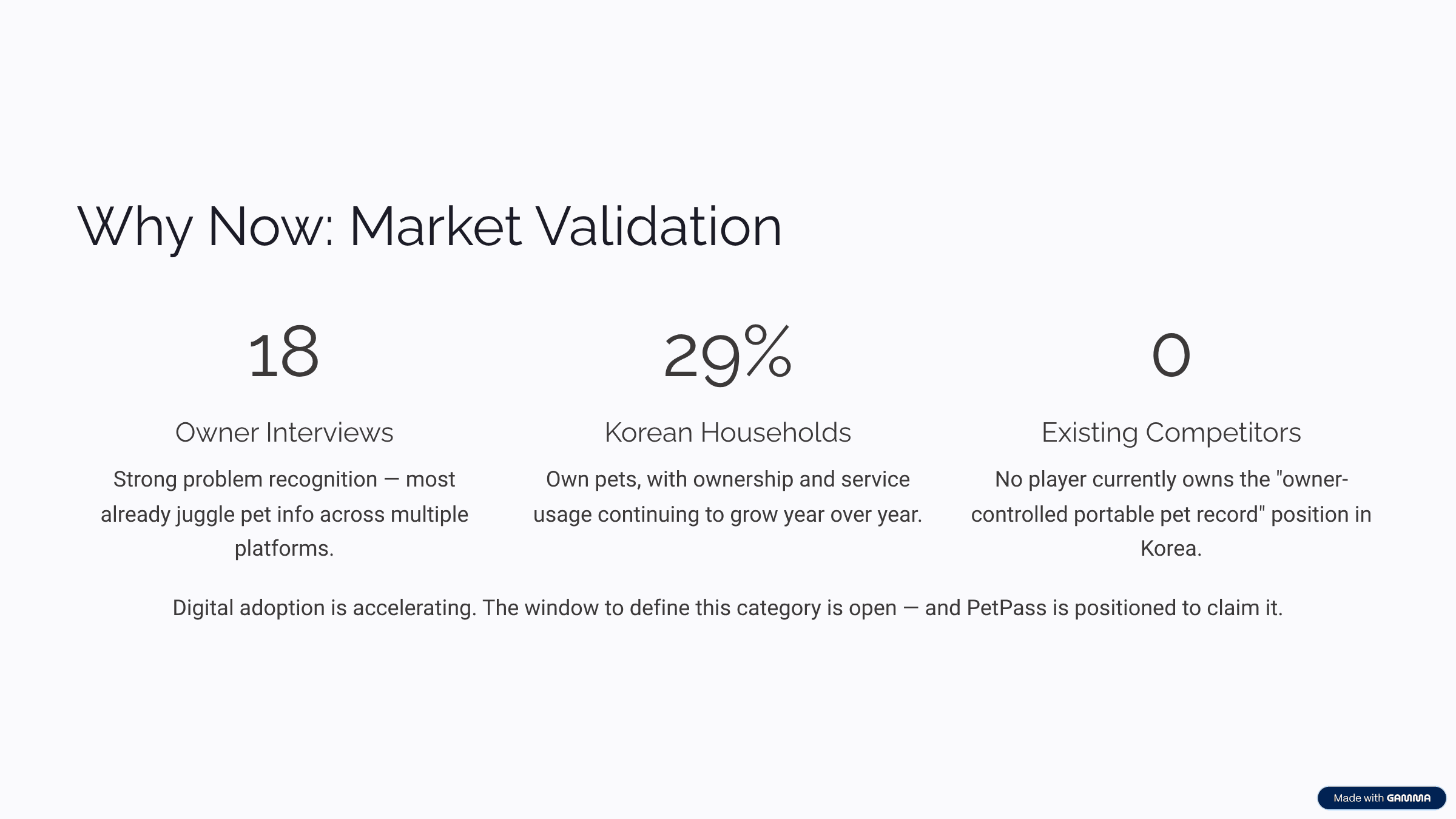
Explain why Now and Why Korea
This is especially important when pitching in Korea. Simply living in Korea is not a reason that your company needs to be built here.
Your pitch should explain what makes Korea particularly attractive for the business. That could be customer behavior, market structure, government policy, infrastructure, industry concentration, demographics, distribution, or some other feature that makes the opportunity meaningfully stronger here than elsewhere.
For PetPass, the argument is that Korea combines substantial pet ownership with dense urban living, frequent use of specialized pet services, and a highly digital consumer environment. The stronger question is not “Can this work in Korea?” but “Why is Korea an especially good market for this to work in?”
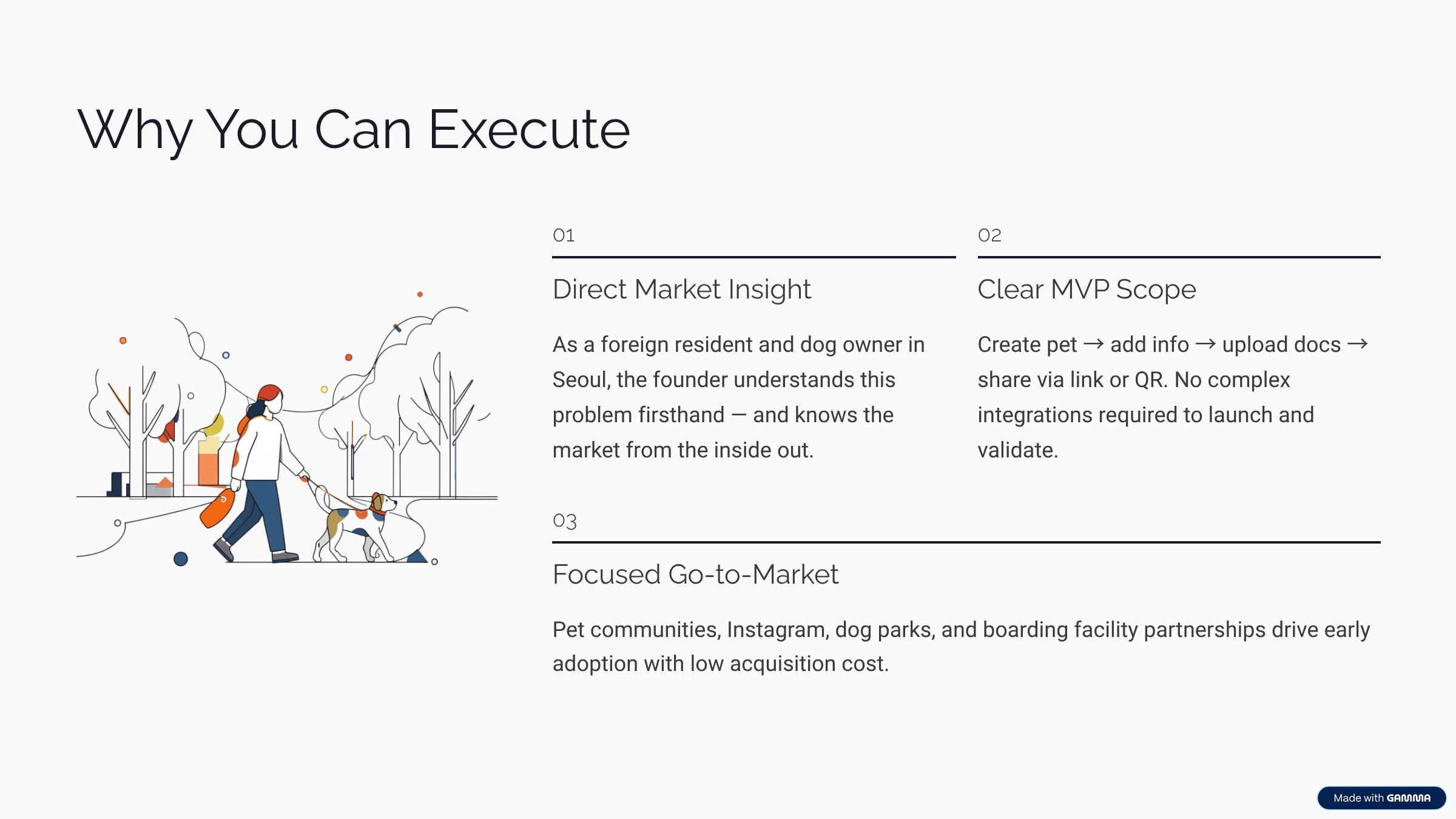
Explain Why You Can Execute
This can be one of the most uncomfortable slides for first-time founders because very few people are uniquely qualified to build exactly one startup. You do not need to invent that kind of story.
Instead, explain why you are capable of moving the idea forward. That might come from relevant professional skills, technical ability, firsthand experience with the problem, industry access, previous execution, or a team whose skills complement one another.
Our fictitious PetPass founder is a pet owner in Seoul who has experienced the problem directly and has defined an MVP that can be tested without complicated integrations. That does not make the founder uniquely qualified, but it does provide a credible starting point. In an early-stage pitch, believable capability is often more convincing than trying too hard to manufacture a perfect founder-market-fit story.
We used Gamma to turn the PetPass concept into the example deck featured in this guide. You can use it to quickly turn your own startup notes into a structured first draft.
A good deck can still underperform if it is difficult to present. A few practical rules help:
Do not depend on animations. Files can be converted, presentation software may behave differently, and animations can break. Anything essential should already be visible on the slide.
Avoid too much text. Slides should support what you are saying, not compete with it. Include enough text to reinforce the point without making the audience read while you speak.
Give yourself a time buffer. If you are given five minutes, prepare for about four and a half. File loading, microphone issues, interruptions, or simply speaking more slowly than expected can easily use the remaining time.
The broader lesson is that a first pitch does not need to make the company look finished. It needs to make the idea understandable and give the audience confidence that you know what you are trying to prove next. A deck is useful because it forces those decisions into the open, where they can be researched, challenged, rehearsed, and improved.
About This Guide
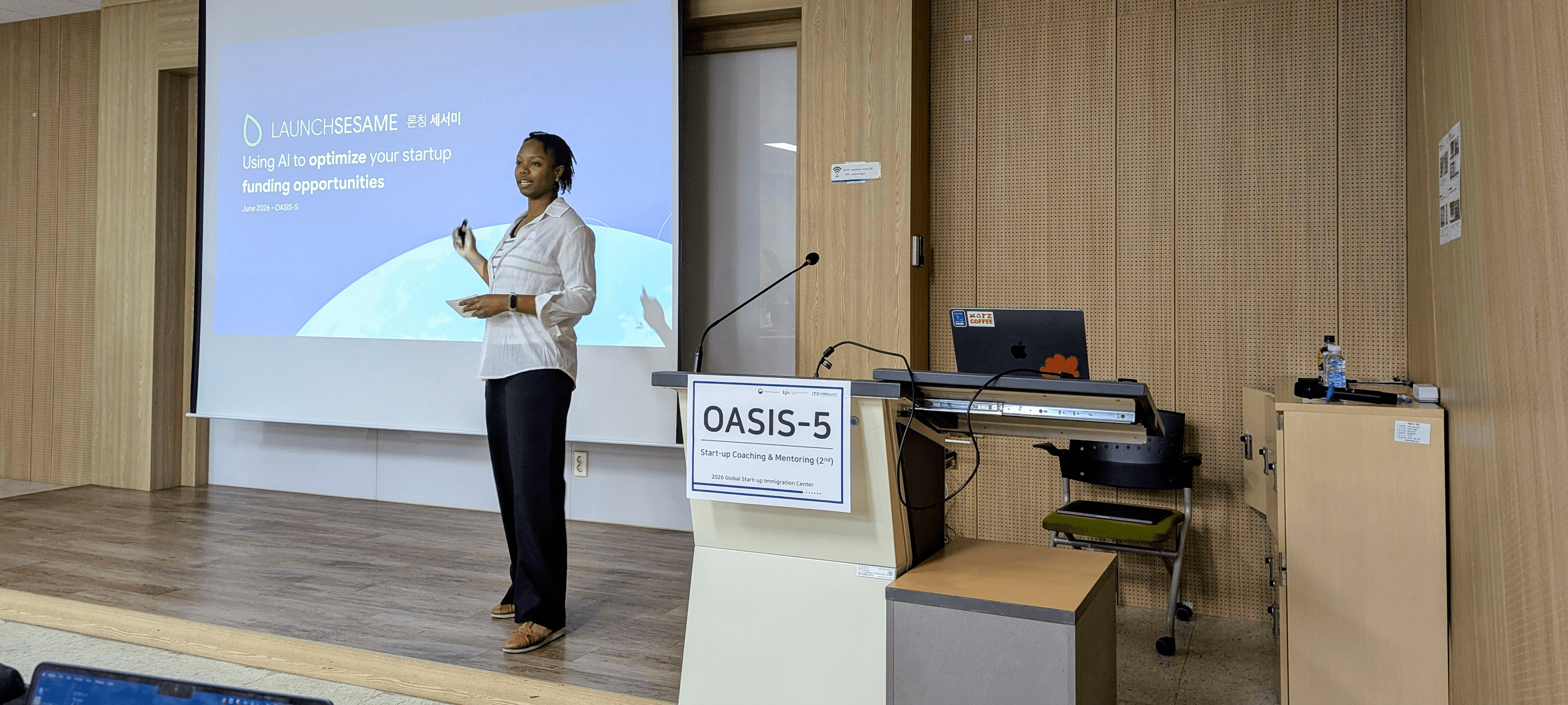
This guide was developed using advice received from OASIS-4 and OASIS-5 business mentors who work with early-stage foreign founders in Korea and help them communicate their business ideas with greater clarity and conviction.
The recommendations here reflect that practical mentoring perspective, combined with Launch Sesame’s own research into the experiences of early-stage foreign founders in Korea.
Frequently Asked Questions
A strong startup pitch deck in Korea should clearly explain the problem, target customer, solution, market opportunity, business model, why Korea is the right market, and why the founder or team can execute. The exact format varies by program, but the core goal is the same: make the business easy to understand and show why it is worth supporting in Korea.
Yes, some Korean startup programs and competitions allow or actively support English-language pitches, particularly those designed for foreign founders or international startups. Others may prefer or require Korean, so always check the specific program rules before preparing your deck. Anecdotally, there are "English-friendly" programs that give bonus evaluation points for presenting Korean as a foreign founder.
For many Korean startup programs, it is not enough to simply say that you live in Korea or want to enter the market. You should explain what makes Korea strategically important to the business, such as customer demand, industry structure, technology adoption, demographics, partnerships, or a market advantage that makes Korea a particularly strong place to launch or grow the company.
People who struggle with this section tend to fall short in justifying their case for government programs in particular.