Overview
Located centrally in Korea's capital, the Seoul Global Center (SGC) stands as a landmark hub for foreign founders. Seoul Global Center delivers the educational foundation non-Korean entrepreneurs need to set up shop in Korea’s capital city by offering nearly all OASIS components—specifically OASIS-1, 2, 4, 4+, 5, 6, 7, and 8.
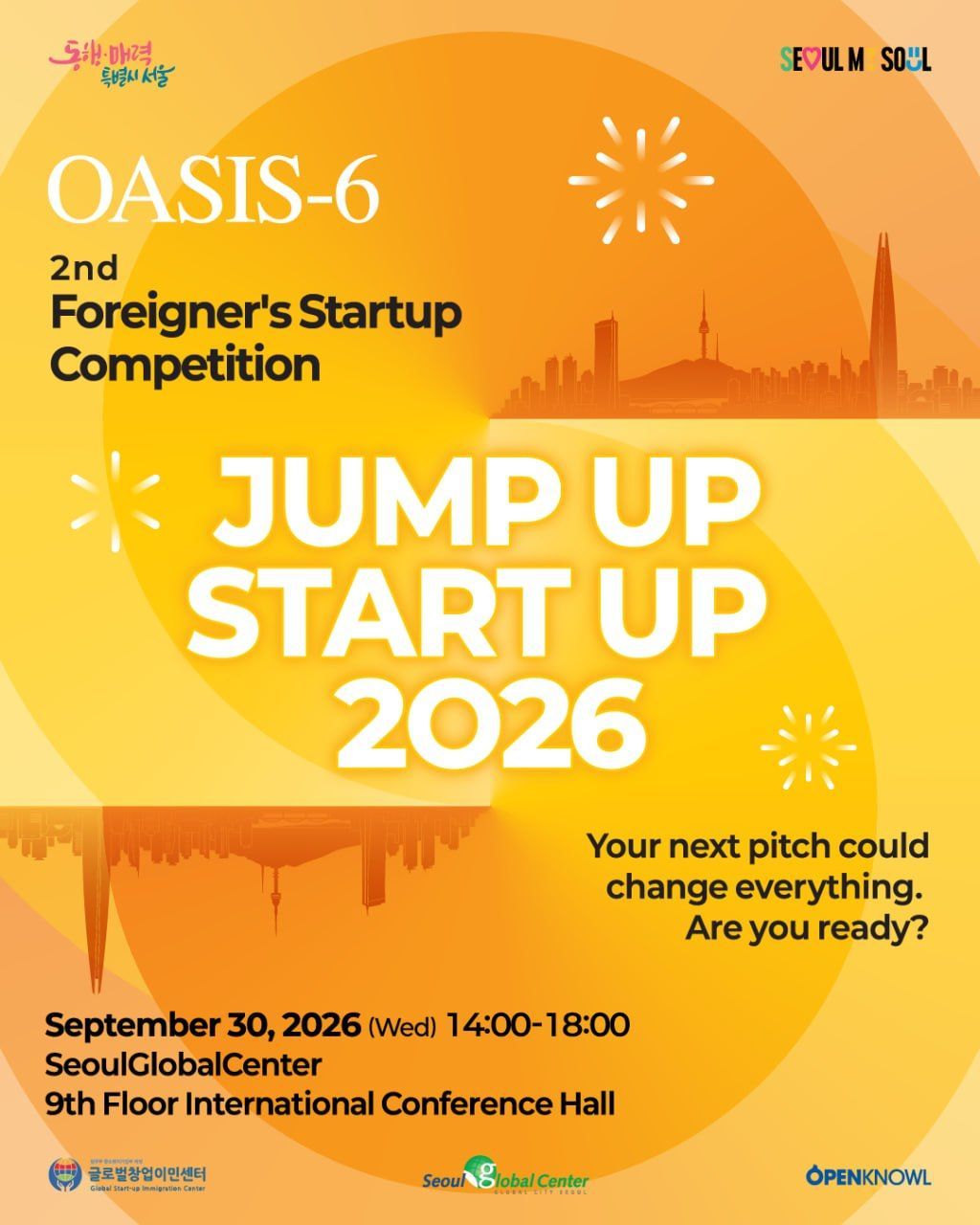
Building on this foundation, SGC is hosting the 2nd Foreigner’s Startup Competition JUMP UP, START UP 2026 under the OASIS-6 (Invention/Startup Exhibition) program. Designed specifically to bridge the gap between ideation and execution, this initiative aims to identify promising tech concepts from foreign entrepreneurs in Korea.
Beyond validating business models, the program directly targets two of the biggest hurdles non-Korean founders face: securing valid points toward a D-8-4 Startup Visa and gaining early traction within the local venture ecosystem. To achieve this, the initiative equips participants with targeted investor feedback to refine their IR materials while connecting them directly to the broader startup infrastructure, both inside and outside the Seoul Global Center. For those interested in applying, understanding how the competition is evaluated is your first step to preparing a strong application and pitch deck.
Before applying, check your eligibility
Round 1: Document Review
Out of all initial submissions, only 10 teams who score an average of 70 points or higher will be selected to move forward to the IR Bootcamp and the final live pitch evaluation. The judges score each team based on the following criteria:
Founder & Team Capabilities (25 Points)
- Entrepreneurial Motivation: Judges look closely at why you are launching this business in South Korea. They want to see a clear, authentic drive behind your vision, alongside a demonstrated understanding of why the Korean market is the right landing pad for your technology.
- Founder & Team Expertise: Your academic background, past domain experience, and technical skill set are evaluated to determine if you have the core competence required to build your product or service. If you are applying as a team, judges assess whether your combined skill sets cover critical operational gaps (e.g., technical development vs. business operations).
Business Model (25 Points)
- Suitability of the Business Model: This section evaluates how your core offering actually works. Judges check whether your value proposition makes logical sense within the current market environment and whether your business structure is legally and operationally feasible in Korea.
- Problem-Solving Approach: Evaluators want to see a clear definition of a genuine pain point. You must clearly articulate who experiences this problem, why existing solutions on the market fall short, and how your specific technology or approach resolves it more effectively.
- Market Potential: Judges assess the Total Addressable Market (TAM) and Serviceable Addressable Market (SAM). These numbers are proof that your target customer segment is large enough—or growing rapidly enough—to sustain a viable, scalable commercial venture.
Business Feasibility (30 Points)
- Specificity of the Business Plan: The panel of judges looks for concrete operational details: realistic timeline milestones, clear budget allocations, accurate cost structures, and practical steps toward product development or launch. Vague or overly broad business ideas are filtered out here.
- Feasibility & Commercial Realism: Evaluators judge whether your business plan can realistically be built and monetized within current technical, financial, and regulatory parameters in South Korea. Overly ambitious goals that lack an operational foundation will lose points.
- Differentiation & Competitiveness: You must demonstrate a clear competitive advantage (moat) over existing market alternatives. Whether through proprietary IP, unique localized features, strategic cost efficiencies, or superior UX, your entry must stand out in a crowded market.
Growth Strategy (20 Points)
- Market Entry Strategy: This criterion examines your go-to-market (GTM) roadmap. Judges look for specific customer acquisition channels, pilot testing plans, B2B/B2C outreach strategies, and local marketing tactics tailored to Korean consumer or corporate behavior.
Revenue Model: Your business must show a clear, logical path to financial sustainability. The committee evaluates your pricing model, monetization streams, unit economics, and cash flow projections to verify how the business will generate revenue.
- Domestic & Global Growth Potential: Evaluators assess how far your startup can scale. While establishing early traction in South Korea is essential, judges favor tech-driven models that carry high potential for cross-border expansion or regional scaling into broader Asian and global markets.
Bonus Points (Up to 8 Points)
Bonus points are applied exclusively during Round 1 to give well-prepared candidates an extra competitive edge:
- Korean Document Submission (+3 Points): Submitting both your official business plan and your IR presentation deck in Korean automatically earns your team 3 bonus points. This signals strong local commitment and reduces operational friction with local evaluators.
- Official Recommendation Letter (+5 Points): Submitting an official letter of recommendation from a recognized Korean university or qualified startup support organization awards 5 bonus points. Qualifying organizations include university startup support centers, business incubators (BI), Centers for Creative Economy & Innovation (CCEI), Campus Town programs,accelerators (AC), venture capital firms (VC), and government-operated startup entities.
Round 2: Pitching Evaluation
After clearing Round 1 and advancing through SGC’s one-day IR Bootcamp and expert 1:1 consulting, the final 10 teams present live before an expert panel. Evaluated live out of 100 points (plus up to 5 bonus points), here is what the judging panel expects during the live pitch:
Founder & Team Capabilities (25 Points)
In Round 2, the focus shifts from your team's background on paper to how effectively you communicate and demonstrate operational leadership in real time.
- Entrepreneurial Mindset: Judges look for authentic founder resilience, vision, and adaptability. They want to see how passionately you believe in your mission and whether you possess the grit required to navigate the realities of running a company in South Korea.
- Presentation Skills: Beyond a well-designed slide deck, evaluators judge your public speaking clarity, storytelling ability, and pacing. You must effectively convey complex technological or business concepts concisely within the strict presentation time limit.
- Execution Capacity: This criterion assesses your team’s ability to turn plans into action. During the Q&A session, judges will probe your operational readiness, domain expertise, and practical understanding of how to manage daily startup operations in the local market.
Business Model (30 Points)
Carrying heavier weight in the live round, this section tests whether your core offering can survive direct investor scrutiny and customer validation.
- Clarity of the Business Model: Evaluators look for a clean, unambiguous explanation of how your business creates, delivers, and captures value. There should be no confusion about who your customer is, what product or service you are selling, or how cash flows through the business.
- Market Validation: Generic assumptions will not pass in Round 2. Judges look for concrete proof of market interest—such as user survey data, active beta testing results, pilot project agreements, letters of intent (LOIs), or early sales traction in Korea.
- Customer Understanding: You must demonstrate a deep, empathetic understanding of your target demographic. Judges evaluate whether you truly grasp Korean consumer behavior, corporate purchasing workflows, or localized pain points better than existing alternatives.
Business Feasibility (30 Points)
Tied for the highest weight in Round 2, this section focuses on commercialization, market defense, and operational realism.
- Commercialization Strategy: Evaluators analyze your immediate, step-by-step launch plan. You must present a clear operational roadmap detailing how you will finalize product development, obtain necessary regulatory approvals, and roll out your service in South Korea.
- Differentiation & Defensibility: Judges assess your competitive moat. You must articulate why local or established competitors cannot easily replicate your solution, highlighting proprietary IP, technical barriers to entry, localized features, or strategic network advantages.
- Growth Potential: Evaluators measure how sustainably your company can expand after launch. They look for realistic scaling pathways that balance initial survival in Korea with long-term commercial viability.
Growth Strategy (15 Points)
While initial domestic feasibility is critical, judges want to see how your venture intends to capture market share and attract future capital.
- Market Expansion Strategy: This criterion examines your long-term go-to-market (GTM) strategy. The panel reviews your plans for scaling customer acquisition, forming strategic corporate partnerships, and eventually expanding from Korea into broader regional or global markets.
- Fundraising Plan: You must articulate a realistic financial growth strategy. Judges evaluate whether you understand your startup's capital requirements, how you plan to deploy funding, and your roadmap for securing local venture capital, angel investment, or government grants.
- Global Expansion Potential: Evaluators favor tech-driven models designed with cross-border scalability in mind. You should highlight how your solution can be localized for adjacent Asian or international markets once domestic traction is established.
Bonus Points (Up to 5 Points)
- Presentation Delivered in Korean (+5 Points): Presenting your live IR pitch and answering the judges' Q&A session in Korean awards an immediate 5 bonus points directly to your final pitch score.
Note: While foreign founders are welcome to pitch in English, delivering a compelling pitch in Korean demonstrates exceptional local integration and drastically reduces operational friction in the eyes of local investors.
We partner with Gamma to help startups build and refine their pitch decks. Copy and paste the evaluation criteria when using the Gamma agent to make sure your deck includes everything the judges are looking for.

×

This is a paid partnership. Learn more.
Prizes, Visa Points, and Ecosystem Support
1. Non-Dilutive Cash Prizes
The top three teams awarded at the Final Competition receive direct monetary prizes alongside an official Certificate of Award issued by the Director of Seoul Global Center:
- Grand Prize (1st Place / 1 Team): ₩2,000,000 KRW
- Excellence Award (2nd Place / 1 Team): ₩1,000,000 KRW
- Encouragement Award (3rd Place / 1 Team): ₩700,000 KRW
2. Strategic D-8-4 Visa Point Breakdown
As JUMP UP, START UP 2026 is under the OASIS-6 umbrella, competing in it provides one of the fastest ways to hit the mandatory 60-point threshold required for the D-8-4 Technology Startup Visa:
- 30 OASIS Points (1st Place Grand Prize Winner): The top winner receives the official OASIS-6 Certificate of Completion, which awards 30 prerequisite points directly toward a D-8-4 visa application. This single award satisfies half of your entire 60-point requirement.
- 15 OASIS Points (Top 3 Award Winners): All three placed finalists earn fast-track eligibility for OASIS-8 (Corporation Establishment Support). Completing corporate registration through this expedited pathway grants an additional 15 points toward your visa total.
3. Acceleration & Incubation Advantages for Finalists
The program’s impact reaches beyond the podium. All 10 Round 1 Finalists unlock critical incubation and mentoring support:
- IR Bootcamp & 1:1 Consulting: Finalists gain access to structured storytelling workshops, pitch strategy sessions, presentation design assistance, and personalized coaching with active local venture experts.
- Incubation Preference (OASIS-7): Finalists receive bonus priority points when applying for resident office space at the SGC Incubator. Securing shared office placement fulfills the OASIS-7 module, adding another 15 points toward your D-8-4 visa while also cutting operational overhead costs.
Timeline & Program Schedule
Application Requirements & Documents
To apply for the competition, obtain all official templates from the SGC Application Drive Folder. All completed files must be converted to PDF format and submitted online.
- Application Form (Using official template)
- Business Plan (Using official template)
- Consent to Collection and Use of Personal Information & Commitment to Fulfill Obligations (Signed and scanned)
- IR Presentation Deck (Free format, maximum of 15 slides)
Summary
For foreign founders who are ready to establish a foothold in Seoul, Jump Up, Start Up 2026 is an opportunity you should seriously consider. Alongside prize money, it fast tracks the visa process and opens doors for legal, office, and institutional infrastructure support.
For official guidelines and announcement details, visit the Seoul Global Center Official Notice. If you have direct inquiries regarding the application process, contact the Seoul Global Center team via email at [email protected] or by phone at 02-2075-4132.